How Language Barriers Are Putting UAE Workforces at Risk
And What HSE Leaders Can Do About It
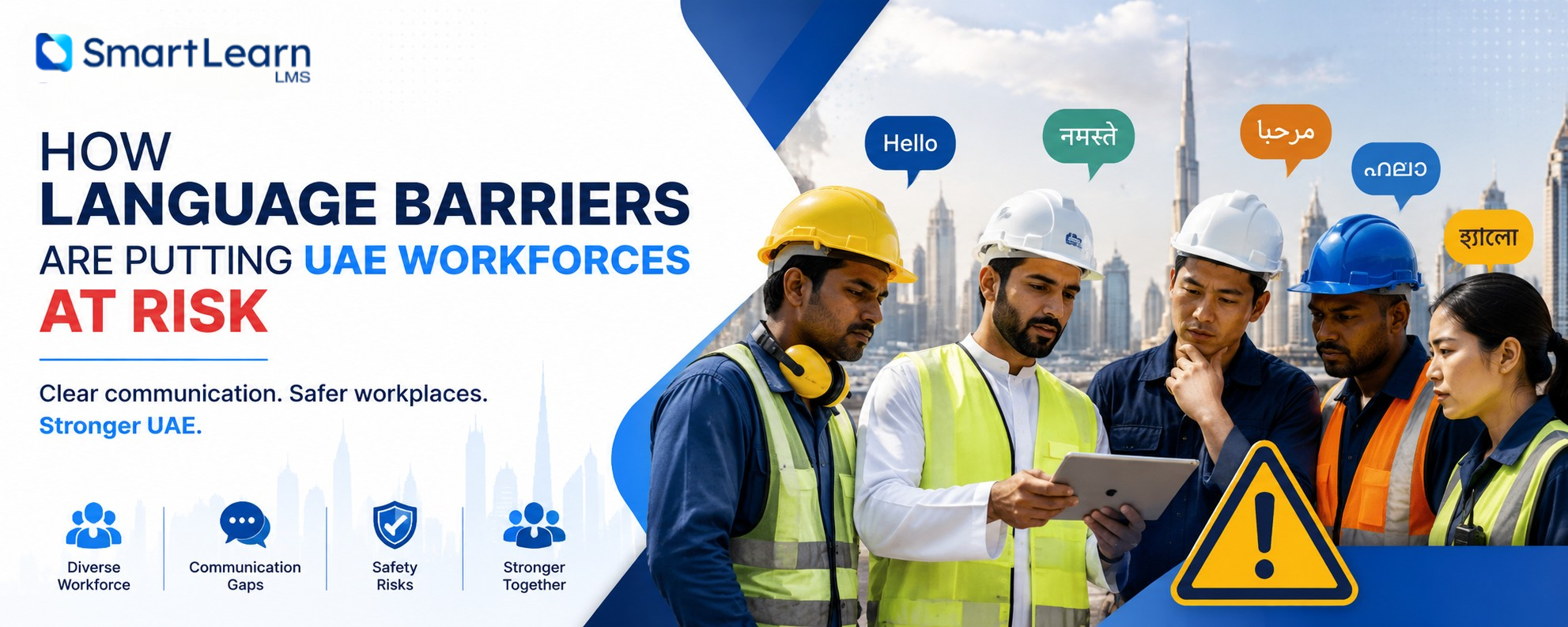
Quick Answer
The UAE's workforce is roughly 88–89% expatriate, drawn from 200+ nationalities, yet most workplace safety training is still delivered in a single language. Research shows language barriers contribute to around 25% of preventable incidents, and UAE law — Federal Decree-Law No. 33 of 2021 and its Executive Regulation — explicitly requires safety instruction in a language workers actually understand. Closing this gap requires more than translation: it requires visual-first, comprehension-tested training design.
How big is the language gap on UAE job sites?
The UAE has one of the most linguistically diverse workforces on earth. Expatriates make up close to 89% of the country's population, and the Ministry of Foreign Affairs counts residents from over 200 nationalities living and working in the country. Migrant labour accounts for roughly 90% of the private-sector workforce, with the largest concentrations in construction, manufacturing, logistics, and facilities management — the exact sectors where a missed instruction can mean a fall, a chemical exposure, or a machinery accident.
On a single UAE construction or logistics site, it is common to have workers who speak Hindi, Urdu, Bengali, Malayalam, Tagalog, Pashto, and Arabic — often with limited proficiency in whichever language the official safety manual happens to be written in. MoHRE's own Safety and Awareness Guide for Workers is published in seven languages, not because seven is a convenient round number, but because that is roughly what it takes to reach the actual workforce.
The problem is not that employers don't know their workforce is multilingual. It's that most safety training programmes were built once, in one language, and never redesigned as the workforce diversified.
What does the research say about language barriers and incident risk?
This is not a theoretical risk. Multiple independent studies on multilingual job sites — most directly comparable to UAE conditions — have quantified it:
- A widely cited study of migrant construction workers found that 85.7% used a language other than the site's primary language at work, 48.7% admitted to misunderstanding on-site instructions, and 66.7% said they had made a mistake directly because of the language barrier.
- Worse, 77.5% said they actively avoided safety training because of language difficulty, and 68.4% reported moderate-to-serious trouble understanding written training material.
- Occupational safety researchers consistently find language barriers cited as a contributing factor in roughly a quarter of on-the-job accidents in multilingual workforces.
The pattern across this research is consistent: workers don't get injured because they're careless. They get injured because they never fully understood the instruction in the first place — and many won't admit confusion in a safety briefing, because doing so carries its own social and job-security risk.
What does UAE law actually require for training language?
The Legal Requirement
Federal Decree-Law No. 33 of 2021 (UAE Labour Law) obliges employers to supply protective means, post awareness materials, and provide appropriate training to prevent occupational injury and disease, with regular assessments to confirm all parties meet occupational health and safety requirements.
The Executive Regulation (Cabinet Resolution No. 1 of 2022) requires that fire prevention and hazard awareness instructions be communicated "in Arabic and in any other language the workers understand, when needed."
That clause is doing a lot of work. It is not satisfied by posting an Arabic-language poster if the crew reading it doesn't read Arabic. MoHRE's own approach — publishing its core safety guide in seven languages — is the regulator modelling the standard it expects employers to meet.
An inspector reviewing your training records is not just checking that a programme exists. Increasingly, they're checking whether it was actually accessible to the workforce that received it.
Why translation alone doesn't solve the problem
Translating a safety manual word-for-word into seven languages feels like compliance, but it usually falls short — for three reasons:
Literacy ≠ language fluency
A worker may speak a language fluently but have limited formal education in reading dense technical text. Comprehension gaps show up even with translated material, let alone paragraphs of translated policy.
Technical terms rarely translate cleanly
Terms like "lockout/tagout," "permit-to-work," or specific chemical hazard classifications often lack precise everyday equivalents in a worker's first language — a literal translation can be technically accurate and still fail to convey the actual danger.
Translation ≠ comprehension
The goal of safety training is not "the worker received the document in their language." It's "the worker understands the hazard and what to do about it." Those are different bars, and only one of them is testable.
How visual-first training closes the gap
The fix gaining traction across UAE manufacturing, construction, oil & gas, and logistics employers is visual-first training design — not as a replacement for language support, but as the primary delivery method, with text as support rather than the main channel.
In practice this looks like:
- Demonstration-based video over text manuals — showing the correct PPE sequence or lockout procedure on screen removes most of the ambiguity a translated paragraph cannot.
- Comprehension-tested pictograms and icons — not assumed to be universally understood, but actually validated with the target workforce before deployment.
- Native-language voiceover and subtitles paired with visual demonstration, so language reinforces rather than replaces the visual.
- Short, scenario-based microlearning instead of long onboarding sessions — comprehension and retention drop sharply in long single-language briefings, a problem that compounds across a language barrier.
- Built-in comprehension checks — so "the worker received the training" and "the worker understood the training" are no longer the same unverified assumption.
This approach also solves the practical scaling problem: one well-designed visual training module with multiple audio/subtitle tracks is far more sustainable than maintaining seven parallel written manuals every time a procedure changes.
A practical audit checklist before your next MoHRE inspection
If you want to know where your programme actually stands, ask these questions:
- Do we know the actual first-language breakdown of our workforce, or are we assuming based on nationality?
- Is core safety training — inductions, toolbox talks, permit-to-work briefings — available in the languages our workforce actually speaks and reads well?
- Can we show evidence of understanding (quiz scores, demonstrated competency, comprehension check sign-off) — not just attendance records?
- Is hazard signage validated for comprehension across our workforce's literacy levels, or assumed to be self-explanatory?
- Do we have a process for updating training language coverage as the workforce composition changes — not just a one-time translation at programme launch?
If two or more of these are uncertain, that's a credible exposure — for incident risk and for documentation gaps a MoHRE inspection could flag.